 ABM
ABM Strategy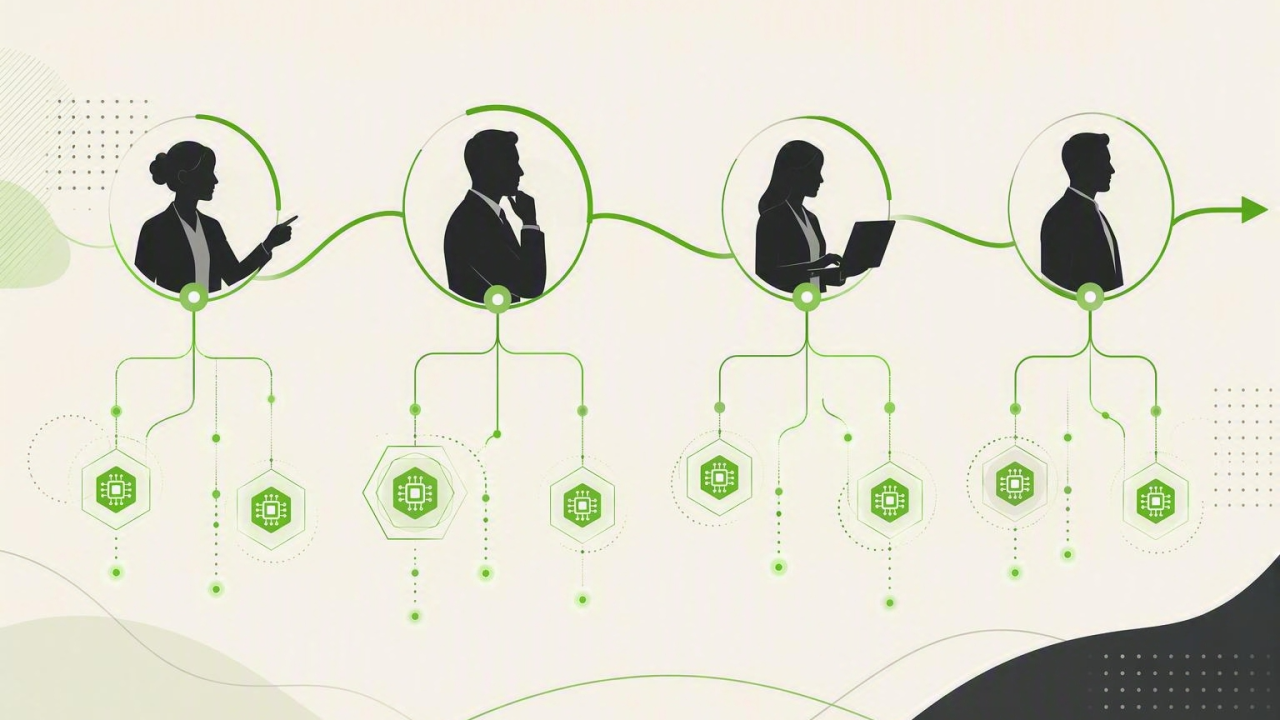
In an AI-fuelled world, B2B buyers are changing the way they buy. Their buying party is larger, they engage sellers later, and when they do, they have mostly made their collective mind up! Are our account-based programs keeping up?
For around two decades, Green Hat has built, run and optimised Account Based Marketing programs across all three plays: 1-to-1, 1-to-Few, 1-to-Many. Here's where we've landed: ABM isn't a nice-to-have layer on top of B2B marketing, it's simply how B2B marketing should be done because we need to move the accounts that matter, and only those, through their buying process toward a decision in our favour.
And yet, we see a pattern emerging. Strategy is collaboratively developed, ICPs defined, target accounts ratified, messaging (eventually) agreed so that on paper, it all looks right. But B2B buying has moved on and traditional ABM has not.
The reflex when ABM underperforms is to blame the strategy: rework the ICP, refresh the messaging, re-cut the account tiers. However, the strategy is rarely broken; what's broken is the operating model behind it, the practical machinery that's supposed to turn strategy into fast, precise, coordinated execution.
The problem with ABM today
The numbers back this up. Nearly 80% of organisations say they're actively executing an ABM strategy, and 84% are doing it to drive revenue outcomes (Demand Gen Report, 2026). The category is growing at 17.9% CAGR (Grand View Research, 2025), so by any measure ABM has won the argument.
ABM maturity (effectiveness) tells a different story. Only 20% say ABM is fully embedded in the business (ITSMA), and only 29% say it's fully operationalised (Forrester). That gap between adoption and maturity is the real story of ABM right now. It isn't about any one team getting it wrong – it's a structural mismatch playing out across the entire industry, where buyers are changing how they buy faster than B2B firms are changing how they sell. Every quarter that gap goes unaddressed, it widens, and the cost compounds.
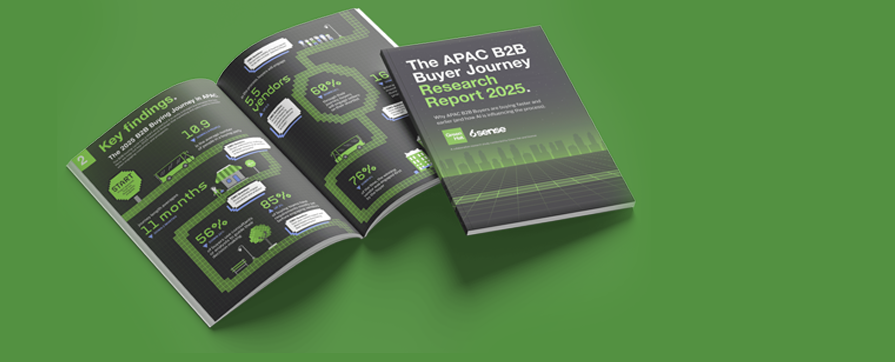
Buying groups now average 11 people. They don't engage a vendor until 60% of the buying journey is already complete.
That's from our own APAC B2B Buyer Journey Research. The target account is over halfway to a decision before it puts its hand up, and by the time the sales team is invited in, the shortlist is largely set, the problem has been framed by someone else, and the preferred vendor is often already emerging.
This is where today’s campaign-based ABM falls over. A campaign only reaches the people who respond to it, and it cannot reach a buying group that has chosen to stay invisible, researching on its own timeline. You cannot run a fixed calendar of campaigns against an account that's already three moves into a game you don't know is being played.
Two things follow from that. First, timing and outreach need to become signal-based rather than calendar-based, so the trigger for action is what an account is doing right now, not what stage your campaign has reached. Second, more investment needs to shift toward account-based reputation building, the work that shapes how an account perceives you long before it's ready to engage. That work lives in the dark funnel, where buyers form opinions through peers, search, communities and content you never see them consume.
It's also where the most important people in the buying group quietly operate. Alongside the solution buyers, who confirm a product solves the business problem, sit the reputational buyers: quieter stakeholders weighing risk to the business and risk to their own standing, who rarely fill in a form.
The fix here isn't more content or more campaigns, it's real-time visibility. Sales and SDR teams need account intelligence and buying signals delivered in near-realtime (hours, days), not reviewed at the next pipeline meeting, so every touchpoint moves the account and buying party forward with the right message at the right time.
Fix the operating model, not the strategy.
It's worth defining what an operating model actually is, because it's often confused with strategy. Your strategy tells you where to play and how to win. Your operating model is the practical system that determines whether you can execute that strategy consistently at a cadence modern buying now demands. It governs how account intelligence is sourced and kept current, how buying groups are identified and prioritised, how marketing, sales and customer success coordinate, how signals get interpreted, how insight becomes content, how channels are activated and how performance feeds back into the system.
That combination of process, technology, data and human coordination decides whether ABM is fast and effective, or slow and fragmented, and it's the part that matters most, yet the part most organisations under-invest in. Most B2B firms invest resources into getting the insights, strategy and messaging right and comparatively less into building a model that can execute it at speed and scale.
Four places execution breaks down
Time-to-market is a challenge. Everyone starts ABM with enthusiasm, especially the Sales org but 'blockers' can easily dampen momentum. Account and segment research, buying-group hypotheses and validating ‘voice-of-customer’ insights become a project unto itself. CVP and messaging frameworks need to move between marketing, sales and leadership for approval before anything goes live, by which time quota-driven sales leaders are getting frustrated and target account situations have often changed.
Quality data is the second blocker, and it's rarely complete: the richest account knowledge sits in a rep's head or a spreadsheet nobody else can find, so contact coverage stays thin, marketing targets whoever is visible, sales engages whoever responds, and the buying group is never seen in full. Deals stall because a critical influencer was never identified in the first place.
Personalisation is the third constraint, and it stays surface-level far too often: an industry variant here, an account name there, none of which moves the needle on relevance. Real ABM needs role-specific, stage-aware content system that learns and adapts, but most models simply can't support that at scale.
Finally, ability to scale is not possible in manualised models; for example, replicating a 1-to-1 program to 10 accounts in a 1-to-Few motion. Small, resourced 1-to-1 programs can work reasonably well by hand, but still we rarely see enough vendor-side committed resource to provide the agility needed to keep pace. Further, the real growth in ABM is happening in 1-to-Few and 1-to-Many plays, now that smarter data and tech platforms make it possible to address larger cohorts with more precision.
Traditional operating models built for demand-gen campaigns and event management simply aren't equipped for that scale: research stays manual, mapping stays incomplete, coordination still relies on meetings and handovers, and effort grows faster than impact.
These aren't four separate problems, they're four symptoms of one underlying issue: that today’s operating model was never built for continuous, orchestrated, timely execution.
Agent and human orchestration: the foundation of the new Account-based Operating Model
We've seen some 'modernisations' in B2B marketing over the last 20 years, with marketing automation probably being the most significant. However, the new opportunity with agentic AI is more than a modernisation. It's a transformational shift to a joined-up model where humans and AI agents orchestrate the entire account-based lifecycle together, from insight through activation through optimisation. In this model, AI isn't a bolt-on tool sitting beside the work. It sits inside the execution layer, letting the whole system run at the speed and scale ABM has always needed but rarely had.
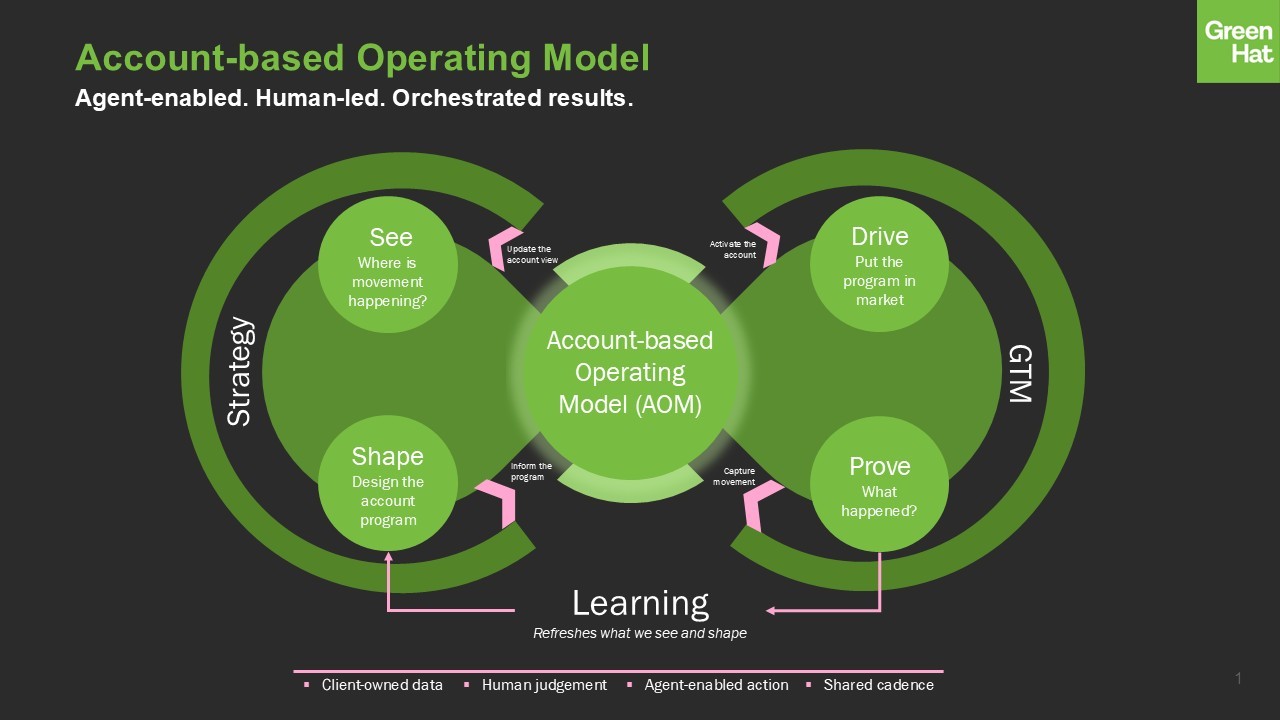
In practice, that turns ABM from a series of stages separated by handovers into something continuous. Account and contact data isn't gathered once at kickoff and left to decay; it's enriched and refreshed constantly, so accuracy improves over time instead of degrading (Buying Party Builder Agent). Buying groups aren't fixed assumptions locked in during planning; they're mapped, refined and monitored as engagement actually unfolds (Executive Engagement Agent).
Signals, whether intent, engagement or behaviour, are read close to real time to prioritise accounts and guide the next best action, rather than reviewed in a fortnightly status meeting (Account Signal Agent). Messaging evolves as we learn more about the account and their journey stage instead of sitting static in a content library (Content Personalisation Agent). Marketing, sales and customer success work from the same data and the same signals, so their actions reinforce each other instead of running in parallel, disconnected lanes (SDR Live Plays Agent).
The role that agents are starting to play and will play changes the ABM game – under the stewardship of human control. And orchestration is the secret sauce. Dedicated agents talking to other agents, and/or to humans who then pass to another agent, or human, provide the platform for marketers to more effectively engage the changing buyer landscape.
The end-to-end operating system is joined up with the appropriate governance and checks and balances. This is why AI genuinely matters here, and why it needs to be built into the operating model rather than bolted onto it after the fact. For CMOs, that translates into more efficient pipeline and far greater confidence in marketing's contribution to revenue. For CROs, it means deeper account penetration and more predictable progression through complex buying groups.
The question for marketing and revenue leaders
If ABM isn't delivering what you expected, the question is no longer "do we need a better strategy?" It's whether you have an operating model capable of executing ABM the way modern B2B buying actually works, because for most organisations, the strategy was never the limiting factor, the system was.
In Part 2, I'll get practical: what this operating model looks like, how to build it, and how to measure commercial results. That is … to move the accounts that matter through their buying process to the ultimate decision of buying our solution. Coming soon.