
 ABM
ABM Brand
Brand Strategy
In a room full of senior marketers targeting government, one comment stood out: “this session feels like a therapy session.” The reason becomes obvious when you look at how decisions actually get made.
We recently brought together a group of senior marketers from large technology and professional services firms. All of them are responsible for driving growth into Australian Government and public sector accounts.
At one point in the discussion, someone paused and said:
“This feels like a therapy session.”
It got a laugh. But it also reflected something real.
Across completely different organisations, operating in different categories and at different levels of maturity, the same challenges kept surfacing. Not just similar problems, but the same underlying tensions. The kind that are rarely shared openly, and even more rarely solved cleanly.
Which points to something bigger.
Government marketing is not just difficult. It is structurally difficult.
The real challenge isn’t procurement. It’s everything that happens before it.
When government marketing is discussed, the focus almost always lands on the visible parts of the process. Procurement, compliance, tenders, long sales cycles. All of these are real and all of them matter.
But they don’t explain why marketers consistently feel like they are operating at a disadvantage.
The more important observation from the session was this: the formal process is not where decisions are made. It is where decisions are confirmed.
As one participant put it, “If we’re not top of mind when they start, there’s a very, very low chance we win.”
Another followed with, “By the time they’re ready to talk to us, they have their shortlist down.”
This shows up in how teams behave. A lot of effort is still focused on activating around visible opportunities, while the real work is happening earlier, when buyers are forming their shortlist and aligning internally.
It also exposes a practical gap. Even when marketers do develop strong industry or account-level propositions, getting those into market is not straightforward. Several participants talked about the challenge of enabling sellers to take a clear, consistent point of view into their accounts. The value proposition exists, but it doesn’t always travel well.
This is where newer approaches are starting to emerge. Tools that feed account insights, recommended actions and messaging directly to sellers in real time are beginning to close that gap. Not because they are replacing relationships, but because they make it easier to act on them.
Government buying is driven by risk, not optimisation.
A second pattern that came through strongly was how decisions are actually made once multiple vendors are in play.
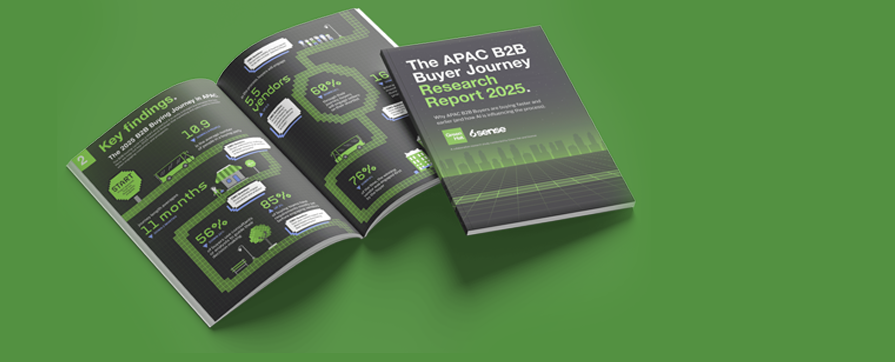
Government buying is rarely about an individual making a call. It is a group decision, often involving 10 to 12 stakeholders with very different priorities. Our APAC B2B Buyer Journey Research report unpacks the way B2B buying groups buy today, explaining the two key phases – Selection and Validation.
As someone described it, “It’s like organising a lunch with 12 people - you end up with a compromise.” The nature of that compromise is important. On one side, you have solution buyers who focus on capability and delivery. On the other, you have stakeholders who are focused on risk, compliance and reputational exposure.
And that second group carries more influence than many marketers realise.
“They don’t want to end up on the front page. That’s the risk they’re managing.”
That perspective explains a lot of what happens in government buying. Decisions are not driven by selecting the best option, but by selecting the option that is easiest to defend. In practice, that often means established providers, familiar approaches and solutions that feel safe to stand behind.
It also explains why brand and reputation matter so much in this space. Not as a nice-to-have, but as a mechanism for reducing perceived risk.
The most important influence is the hardest to see.
Part of what makes this environment so challenging is that much of the decision- making sits outside of direct observation.
Several participants highlighted that the people who influence outcomes are often the least visible. Reputational stakeholders, procurement teams, and external advisors such as consultancies or government agencies all play a role in shaping decisions.
At the same time, the buying behaviour itself leaves very little trace. As one attendee said: “They’re doing their research, but they’re not showing up in our systems.” This creates a disconnect between activity and feedback. Marketers can run campaigns, invest in accounts and build presence, but the usual signals of engagement are weaker or absent. Even something as simple as a LinkedIn interaction can’t be relied on, because buyers are often reluctant to publicly engage with vendor content.
The net effect is that marketers are often operating without clear signals, trying to influence decisions that are already in motion and largely invisible.
Limited Go-To-Market options.
A recurring frustration across the group was the limited set of go-to-market options available.
“What do I do when you can’t wine and dine, can’t send things… what’s left?”
It is not just a question of creativity, but of constraint. Government environments restrict many of the tactics that B2B marketers typically rely on. That leaves teams with a narrower set of channels and fewer opportunities to generate visibility.
In practice, this leads to a set of default activation choices. Targeted media in publications like The Mandarin. Out-of-home placements in Canberra. Presence in the environments where government buyers physically spend time. These channels serve a purpose, but they also highlight the broader limitation. When options are constrained, activity can become predictable. What stood out in the discussion, however, is that the teams making progress are not trying to overcome the constraints. They are working within them.
They focus on smaller, more targeted engagements. Curated events that create genuine value. Deep alignment with sales teams and existing relationships. In other words, precision rather than scale.
AI is increasing expectations and amplifying risk.
AI was part of the discussion, but not in the way it often is in marketing conversations.
There is growing pressure on vendors to articulate an AI story. Buyers expect it. In some cases, they are even initiating conversations earlier to understand how AI fits into a solution. At the same time, the reality inside government is more cautious. “They are terrified. They don’t have the guardrails.”
That caution extends to both sides. Buyers are restricted in how they can use AI as part of their evaluation process, particularly where data, security and policy concerns are involved. On the vendor side, there is also increasing scrutiny around how AI is used in delivery.
In some organisations, this is already having a practical impact. Teams are consciously limiting AI usage in certain contexts, relying more heavily on human-generated outputs where trust and assurance matter most which creates a nuanced challenge. AI can strengthen a proposition, but it can just as easily introduce doubt. In a risk-led environment, that balance matters more than the technology itself.
Measuring progress requires a different lens.
The final challenge discussed was measurement.
Long sales cycles and multi-stakeholder buying groups make it difficult to rely on traditional metrics. A single interaction or lead provides limited insight into whether progress is being made. As one participant put it, “We are measured poorly, especially in public sector with its length.”
What matters in reality looks different. How many stakeholders are engaged within an account. Whether the brand is being considered early. How influence builds over time. These are not easy things to measure, but they are closer to how decisions are actually made.
Why it feels like a therapy session.
Coming back to that initial comment, it is not hard to see why the session felt the way it did. Government marketers are operating in a system where influence is largely invisible, decisions are shaped early, and risk outweighs differentiation. At the same time, they are working with a constrained set of tools, limited feedback loops and growing pressure to demonstrate impact.
None of that means the system is broken but it does mean it behaves differently.
The opportunity for marketing is not to fight that reality, but to align to it. To focus on early influence, broader buying group engagement, and enabling sellers to act with more context and clarity. Because the real work does not happen when the process becomes visible.
It happens well before that.

.png?width=900&name=1_Header_greenhat3480_httpss.mj.runj-wU89NoA9w_retro_computer_style_of_8cc55aa8-8e51-48cc-b08e-926fde511b76_0%20(1).png)