
 Strategy
 Advertising
 Demand Generation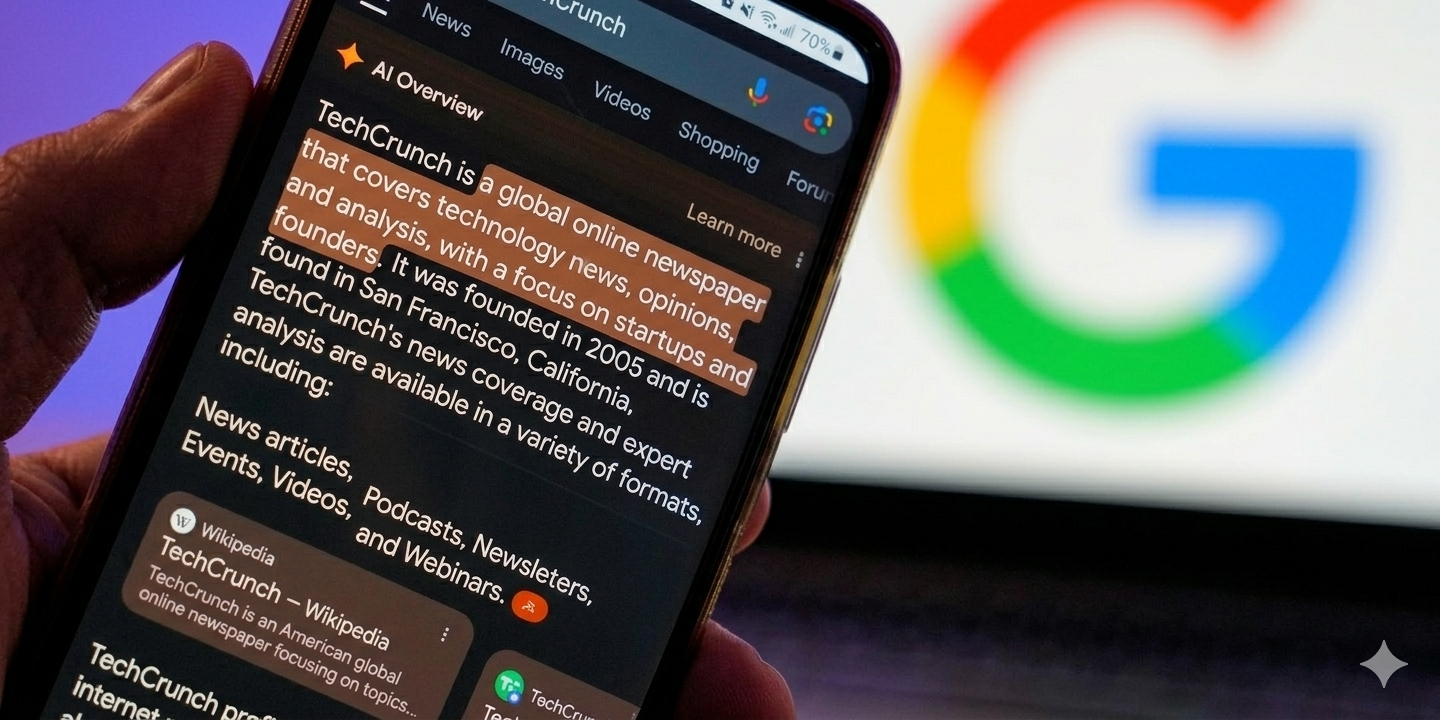
Three years ago, I wrote for Mi3 about the “un‑Googling” of search, asking whether AI-supported search could change customer behaviour and force B2B marketers to rethink discovery beyond ads and search.
The clear provocation then was Bing. Microsoft had put AI into search, Google looked briefly exposed, and marketers were asking the usual comforting question: Is this a channel shift, or just another platform panic?
Three years on, the answer is awkwardly neat.
The future‑cast was directionally right. The mechanism was wrong.
Google did not get un-Googled by Bing. Google is still very much alive. StatCounter has Google at about 90 per cent of global search share in April 2026, with Bing just over five per cent. So no, the empire did not fall because someone put a chatbot in a blue browser bar.
But something did change.
Search stopped being only a traffic system. It became an answer system.
That sounds like a small distinction.
It isn’t.
What changed?
The old search bargain was reasonably simple.
A buyer had a question. Google showed a page of links. The brand fought to appear. The user clicked. The website did its work. Marketing measured the visit, retargeted the user, fed the dashboard and told sales that the funnel was alive and well.
AI search interrupts that bargain.
The buyer still asks the question. But the answer may now be summarised inside Google, ChatGPT, Perplexity or whatever interface happens to be sitting between the buyer and the web. The source may be cited. It may not. The brand may be represented accurately. It may be flattened into a bland category paragraph. The buyer may click through. Or they may move on, already carrying a view.
That is the click issue, in plain English.
The old model assumed the click was the moment a brand earned attention. AI search weakens that assumption. A buyer can ask a question, read a summary, compare options, absorb proof points and form a view before they ever visit a vendor site.
So, the issue is not that clicks disappear entirely. They don’t. The issue is that more of the buyer’s thinking can happen before the click, outside the brand’s analytics, retargeting and conversion path.
Pew’s 2025 research gives the issue some shape. When Google users saw an AI summary, they clicked on a traditional search result in 8% of visits. When they did not see an AI summary, they clicked almost twice as often, at 15%. Links within the AI summary were clicked in just 1% of visits.
For publishers, that’s a traffic problem. For B2B marketers, it’s a visibility and interpretation problem: the brand can be influencing the buyer, losing the buyer or being misrepresented to the buyer, without any obvious visit to measure.
B2B buyers were already doing a lot of invisible research. AI search simply gives them a better cloak. The old dashboard may still be working.
The buyer behaviour behind it may have moved.
The marketing objective shifts from search ranking to answer presence.
What I got right in 2023—and wrong
What held up: AI has made search more conversational, more compressed and more answer led. It has pushed search beyond the SEO team and into brand, demand, content, sales enablement and buyer decision-making.
What didn’t hold up: Bing didn’t become the new king. Google didn’t fold. The search monopoly didn’t crack in the satisfying way commentators briefly imagined. It made for a good story though. It just was not the story that played out.
What happened was more awkward and more important: Google began un-Googling itself.
AI Overviews changed the relationships among query, source, and click. ChatGPT added search. Perplexity made citation-led answer browsing feel normal. And then, quietly but inevitably, AI search began to become an ad product.
That last bit is what moves this from ‘futuring’ to marketing.
OpenAI began testing ads in ChatGPT in February 2026. Mi3 has since reported that the pilot is expanding into Australia and New Zealand, while OpenAI has announced partner buying, a beta self-serve Ads Manager, cost-per-click bidding, and expanded measurement tools.
So this is no longer a tidy debate about whether AI changes search behaviour. It is becoming media. Measurement. Brand safety. Performance marketing looking for a new acronym to quietly ruin.
The marketing object changes from an SEO report to a combined visibility, citation, and paid AI media view.
The next question is not whether AI search keeps growing.
It probably does. The more useful question is whether marketers understand what kind of channel they are walking into—and whether the economics underneath it can hold.
This is where the story gets sharper.
AI search is becoming a marketing channel; at the same time, the economics of AI are contested.
On one side is the Sam Altman view of the world: demand is huge, compute is the constraint, and infrastructure must be built ahead of the market. OpenAI’s Stargate announcement framed the race in exactly those terms, with a stated plan to invest US$500 billion over four years in AI infrastructure for OpenAI.
On the other side is the Ed Zitron view: the economics may not make sense, the cash burn is extraordinary, and the leading AI businesses may be racing to find durable revenue before the subsidy runs thin.
Both can be partly right.
Demand can be real, and the model can still be fragile. Usage can be enormous and under-monetised. The product can be useful and over-capitalised. Marketers, of all people, should be comfortable with this contradiction. We have met “brand love” in a quarterly pipeline review.
That is the race on the shortening runway.
If AI search becomes a durable behaviour but the economics tighten, the likely outcome is not retreat. It is monetisation: more ads, more enterprise tiers, more partner buying, more measurement tools, more pressure to prove that AI attention can be bought, attributed and reported.
The marketing object changes from a channel bet to a risk-adjusted AI visibility plan.
This is where GEO enters the room.
Generative Engine Optimisation is not a beautiful phrase. It sounds like something invented in a meeting where everyone had too much coffee. But the discipline behind it is real enough.
SEO asked: Can buyers find us?
GEO asks: when an AI system explains the category, frames the problem, compares options or recommends vendors, do we appear—and are we represented accurately?
That second half is the bit that many B2B brands are not ready for.
At Green Hat, this has moved from theory to live client work. We are seeing it in AI-integrated strategy workflows, agentic build, GEO diagnostics and reporting, and B2B messaging systems that need to work for both humans and machines.
The pattern is consistent: brands often have content, case studies, credentials and campaigns. What they do not always have is a clear enough evidence architecture for AI systems to retrieve, summarise and recommend them accurately.
In practice, this changes the work:
-
Brand propositions need to be sharper, because vague brands are easy for machines to flatten.
-
Proof needs to be structured, because scattered credibility is not the same as retrievable credibility.
-
Content needs to answer buyer questions cleanly, not simply perform thought leadership.
-
Reporting needs to track AI visibility, citations, summaries, shortlists and competitor comparison—not just rankings and clicks.
The marketing object changes from a keyword list to a machine-readable proof architecture.
The next future-cast should probably be less dramatic and more useful.
Not “search dies”. Not “Google dies”. Not “SEO dies”. We have been killing things in marketing for twenty years, and most of them keep invoicing.
The better set of bets looks like this:
-
Paid AI search arrives before organic AI visibility is understood. ChatGPT ads, Google AI surfaces, and partner-buying models become testable media channels, while most brands are still working out how they appear organically in answers.
-
GEO becomes a serious B2B discipline. Not as an SEO rebrand, but as a practical operating layer across positioning, proof, content, sales enablement and measurement.
-
The bubble-pop risk accelerates monetisation. If the runway shortens, the free layer gets thinner, ads get more common, enterprise products get priority and partner routes become more important.
-
Google may benefit from any correction. If challengers struggle with economics, Google still has distribution, infrastructure and an ad machine that knows how to turn intent into invoices.
-
Buyer behaviour doesn’t fully go back. Even if some AI models consolidate or reprice, buyers will still expect summaries, comparisons, recommendations and shortlist support.
That is the part B2B marketers should watch. Not because we need another panic cycle. We have enough of those, usually with panels.
Because the behaviour may persist even if some business models don’t.
The marketing objective changes from a campaign plan to an answer strategy.
Three years ago, the question was whether AI would un-Google search.
Three years later, the better question is whether AI has unbundled the commercial value of search from the click.
That is a different problem for B2B marketers.
Rankings still matter. Traffic still matters. Paid search still matters. But they no longer tell the whole story of how a buyer forms a view before they speak to sales.
The next battleground is not just visibility. It’s interpretability.
When a buyer asks an AI system who matters in a category, what problem needs solving, which vendors belong on the shortlist, what proof exists and what trade-offs they should consider, the brand has a new job.
Not just to be found. To be understood correctly.
That is where GEO becomes more than a fashionable acronym. It becomes a practical discipline for B2B growth: part positioning, part proof, part content, part search, part sales enablement, part measurement.
The executive decision is pretty clean.
Do not treat AI search as a strange sub-branch of SEO. Treat it as the next interface between brand, demand and buyer confidence.
The marketing object is a GEO operating model: what the brand wants to be known for, what proof supports it, where that proof is published, how it is structured, how it appears in AI answers, how competitors are being represented, and how sales can use the same evidence when the buyer finally appears.
The click may still happen. By then, the buyer may already know who they trust.
Read the original: The un-Googling of search: B2B’s new wrangle | Mi3



%20Blog_Blog%20header%20image_1200x1200.png?width=900&name=ZZ%20GH%20Marketing%20Task%20Golden%20Bee%20Awards%20(Kilcoy)%20Blog_Blog%20header%20image_1200x1200.png)