 Strategy
.png)
What you need to know
- In 2026, B2B growth in APAC will hinge less on AI hype and more on clarity and value— a distinctive narrative, clear proof of impact and a tight understanding of buying groups.
- Buyers are engaging vendors earlier, but still choose from a narrow shortlist, so brands must frame the category, show evidence and be easy to defend internally long before a sales conversation.
- AI will run through go-to-market, but most enterprises need to fix data, governance and a few high-value use cases before “agentic” revenue engines are realistic.
- The real edge will come from orchestrating buying groups, elevating real experts and treating agencies as strategic growth infrastructure, not campaign suppliers.
Why we’re making these predictions now
Inspired by Forrester’s recent 2026 predictions, I wanted to reflect on what we’re seeing at Green Hat and share my own view on what will define B2B growth next year in APAC.
In 2026, I believe B2B growth will be won by brands that can clearly position their brands and products, prove the value they create, and orchestrate complex buying groups. That’s what our work in 2025 has shown us—in both the “winners” and the brands (and agencies) that are struggling to keep up.
You’ll notice I’m not leading with AI. That’s deliberate. AI will be woven through almost every part of the go-to-market engine—discovery, targeting, content, measurement—but it won’t fix a value proposition that isn’t clear, differentiated, or aligned to how customers see their problems. If you don’t know why buyers should choose you, AI just helps you say the wrong thing, faster.
Forrester talks about a global “race to trust and value”. From where we sit in APAC, that race is very real—but the winners will be the brands that compete on clarity and value: a clear story, clear proof, clear buying-group orchestration, clear AI foundations and clear expectations of their agencies.
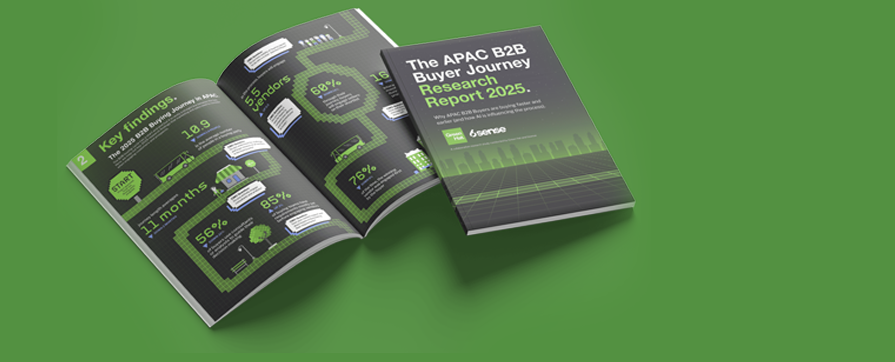
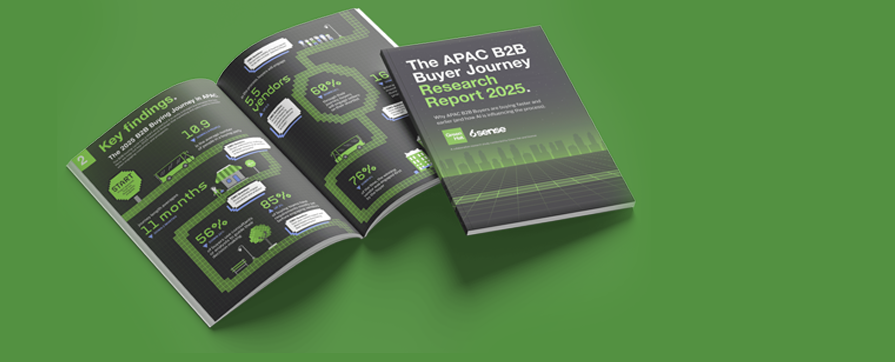
Our own B2B buyer research shows journeys getting tighter and more decisive. Buying cycles are shortening to around 11 months. Buying groups are still large, but they’re engaging vendors earlier. The winner almost always comes from the original shortlist—and most of the time, the vendor ranked first at the end of the Selection phase goes on to win. Under flat or constrained budgets, every experiment has to earn its keep.
Taken together with the programs we’re running for SAP, REA Group, ANZ, Korn Ferry, Grant Thornton, McCain and others, these are the five predictions we’re making for 2026—and how B2B leaders in APAC can compete beyond the race to trust.
Prediction 1: In 2026, the brands that win will tell a distinctive story—and prove it
By the time a buying group is ready to talk, they’ve already done most of their thinking. They’ve defined requirements, screened the obvious options and quietly narrowed the field. The vendor that wins is usually a name they already know and can defend internally.
In that environment, two things become non-negotiable:
 |
A distinctive narrative and position You need a clear answer to “what do we stand for in this category, and where do we credibly win?” – expressed in language that maps to how customers describe their problem and mission, not your product hierarchy. |
 |
A proof layer that stands up to comparison Claims only get you so far. Buying groups are looking for tangible outcomes, benchmarks, implementation stories and references that make your story believable when they stack you against alternatives. |
This is where Discovery, for us, does the heavy lifting. When we run Discovery, we’re not hunting for a clever strapline; we’re reframing the category, testing where you have the right to win, and building a message architecture that everyone—brand, sales, product, CX—can actually use.
In my experience, the content that moves the needle in 2026 will be specific, situation-led and evidence-rich. High-substance beats high-volume.
Questions for 2026
- Could a stranger read your homepage and understand, in one scroll, what you believe, where you win, and what proof you have?
- If AI scraped your content tomorrow, would it find a distinctive story—or just another way to say what everyone else says?
Prediction 2: In 2026, AI will run through go-to-market—but foundations will matter more than agents
Forrester describes a new phase of AI in B2B: less experimentation, more governance, and the rise of agents in revenue operations. We broadly agree with the direction—but the timing looks different from our research and client experience.
On the buyer side, AI is already everywhere. Buying teams use LLMs to research vendors, summarise long documents, stress-test options and draft internal business cases. It’s one reason they’re engaging sellers earlier: AI raises detailed questions about “AI-inside” capabilities, pricing, data use, privacy and training that most websites don’t answer well.
On the vendor side, many organisations we work with—particularly in complex environments—are still untangling the “basics”: fragmented data, long-term microservices programs, inconsistent identity, and risk teams racing to catch up with AI (nothing basic there). In some cases we’re already seeing what Forrester warns about: ungoverned genAI pilots burning cash and confidence, and AI investment being slowed or pushed out until value and risk are clearer.
Our prediction: 2026 is the year you get your narrative, data and workflows ready for agents—not the year most enterprises live in fully agentic revenue operations.
That means:
 |
Focusing on a handful of end-to-end AI use-cases in marketing and sales (like routing, scoring, content ops, forecasting) things that you can govern properly, instead of ten disconnected pilots. |
 |
Being super transparent about the AI components of your own offerings—a clear “AI-inside” story that explains capability, data, security and accountability in plain language. |
 |
Treating GEO and AI-driven discovery as part of positioning and content strategy, so your differentiated story shows up in AI answers, not only on search results pages. |
We do expect agents to show up in tightly scoped, lower-variance areas—payments, routine quotes, simple renewals. Our caution is about assuming the whole revenue engine will be agent-led by 2026, especially in regulated and multi-region APAC environments.
Questions for 2026
- Would a buyer reviewing your content understand what your AI actually does, how it works, and where the risks and responsibilities sit?
- Which two or three AI use-cases could you operationalise end-to-end next year—with governance—instead of spreading effort thin across many?
Prediction 3: In 2026, growth will depend on how well you orchestrate the buying group
We talk a lot about “leads” in B2B. Buyers don’t. They talk about projects, missions and committees.
Our APAC research still shows a two-phase journey—Selection then Validation—but the tempo is changing. Buying cycles are a little shorter, budgets are tighter, and buyers are contacting vendors earlier. What hasn’t changed is this: complex deals are decided by buying groups, and the eventual winner almost always comes from the original shortlist.
In that context, traditional lead-based models start to creak. You can have a full funnel and still lose if you never win the room.
Our prediction: 2026 is the year leading B2B brands stop optimising for lead volume and start designing for buying-group orchestration.
Practically, that looks like:
 |
Shifting your primary lens from MQLs alone to marketing-qualified accounts and buying-party engagement. |
 |
Using Discovery to understand the missions and risks of both solution buyers (who care about functionality and fit) and reputational buyers (who care about risk, optics and defensibility). |
 |
Using ABM / ABX as the operating model for complex deals—a way to align media, site experiences, content, sales plays and customer marketing around a shared account plan. |
The programmes that are outperforming in APAC all have one thing in common: the whole go-to-market engine is pointed at the buying group, not at individual form fills.
Questions for 2026
- If you looked at your dashboards today, would you see individuals—or would you see buying groups?
- How many of your “top accounts” have a clear plan for Selection and Validation, not just a campaign attached?
Prediction 4: In 2026, human expertise and evidence-rich content will be your sharpest differentiator
There will be more content in 2026 than any of us would like—and a lot of it will be AI-generated. Buyers know that. They’re already filtering for what feels human, specific and accountable.
Forrester predicts a renewed emphasis on experts and influencers. Our APAC view is that the desire for expertise is very real, but where buyers look for it is shifting. They are using AI and peer networks where they used to rely on analysts, and they’re leaning more on vendors for candid, contextual guidance earlier in the journey.
Our prediction: in 2026, the brands that win complex deals will treat expertise and content as one ecosystem—not separate worlds.
That means:
 |
Putting product, industry and implementation experts in front of customers earlier, with a shared narrative from Discovery, not a patchwork of decks. |
 |
Building high-signal assets those experts can stand behind: honest AI-inside explainers, scenario walk-throughs, selection-phase guides and “defensibility packs” stakeholders can take to a CFO or board. |
 |
Using AI to amplify that expertise—summarising, tailoring, repackaging—without letting it flatten the point of view. |
Globally, B2B brands will spend more on “expert voices”—but in APAC, that won’t look like big influencer programs. It will mostly come from your own people and your own customers: product specialists, implementation leads, industry experts, and credible customer advocates. These are the voices buyers trust most in complex decisions.
Questions for 2026
- If a buyer asked your best expert “What do you really think?”, would their answer match what’s on your website?
- How much of your content library would your own experts be genuinely proud to put their name to?
Prediction 5: In 2026, winning brands will treat their agencies as strategic growth infrastructure
Behind all of this sits an uncomfortable reality: the brief to agencies is getting more complex, and the pressure on teams is getting heavier.
CMOs are asking the same partners to help with brand positioning, ABM, digital experience, content, AI use-cases, sales enablement and measurement—often across multiple regions and business units. At the same time, many client–agency relationships are still structured as if we’re just buying and selling campaigns.
Our prediction: in 2026, the brands that make the most progress will treat their agencies less like suppliers and more like part of their growth infrastructure.
In practical terms, that means partnering with agencies that:
 |
Bring a point of view on where the category is going, not just what the next asset should say. |
 |
Invest in business understanding, so they can challenge briefs and connect brand, ABM, DX and AI into one coherent model. |
 |
Act with a prevention mindset—helping you anticipate issues, manage change and protect team health on both sides, not just scramble when something breaks. |
At Green Hat, that’s the standard we’re holding ourselves to: using Discovery to anchor positioning, then working with clients over time to turn that into brand platforms, ABM programs, digital experiences and, increasingly, AI-enabled go-to-market. It’s slower to pitch, but faster to grow.
Questions for 2026
- If you mapped your agency relationships today, which ones feel like infrastructure—and which ones feel like suppliers?
- Does your lead agency know enough about your business to argue with you constructively?
My closing thought
If there’s a thread running through these five predictions, it’s this: beyond the global race to trust, APAC B2B brands will compete on clarity and value.
A clear, differentiated narrative. Clear proof of impact. Clear focus on buying groups. Clear roles for AI and expertise (experts). Clear expectations between clients and agencies.
And all of this will matter even more because 2026 will be noisy, noisier even than 2025. New AI tools, new platforms, new metrics, new language. Some of it will be genuinely useful; a lot of it will be distraction. Buyers, boards and teams will still be trying to answer the same grounded questions: What do you stand for? Why should we trust you? What happens if we choose you and it goes wrong?
The brands that win won’t be the ones shouting the loudest about innovation. They’ll be the ones who can articulate—calmly, consistently and credibly—who they are, where they create value, and how they’ll stand behind it. And then prove it in how they show up for buyers and customers.